BACK
Coca-Cola Carter's Lemonade
Pitching end-to-end omni-channel campaign concept for Coca-Cola product, including packaging design, brand identity, and market fit
Graphic Designer
March 2025 (2 weeks)
Figma
Adobe Illustrator
Adobe Photoshop
Google Slides
Marketing Research and Strategy
Graphic Design
Digital Mockups
OVERVIEW
Background
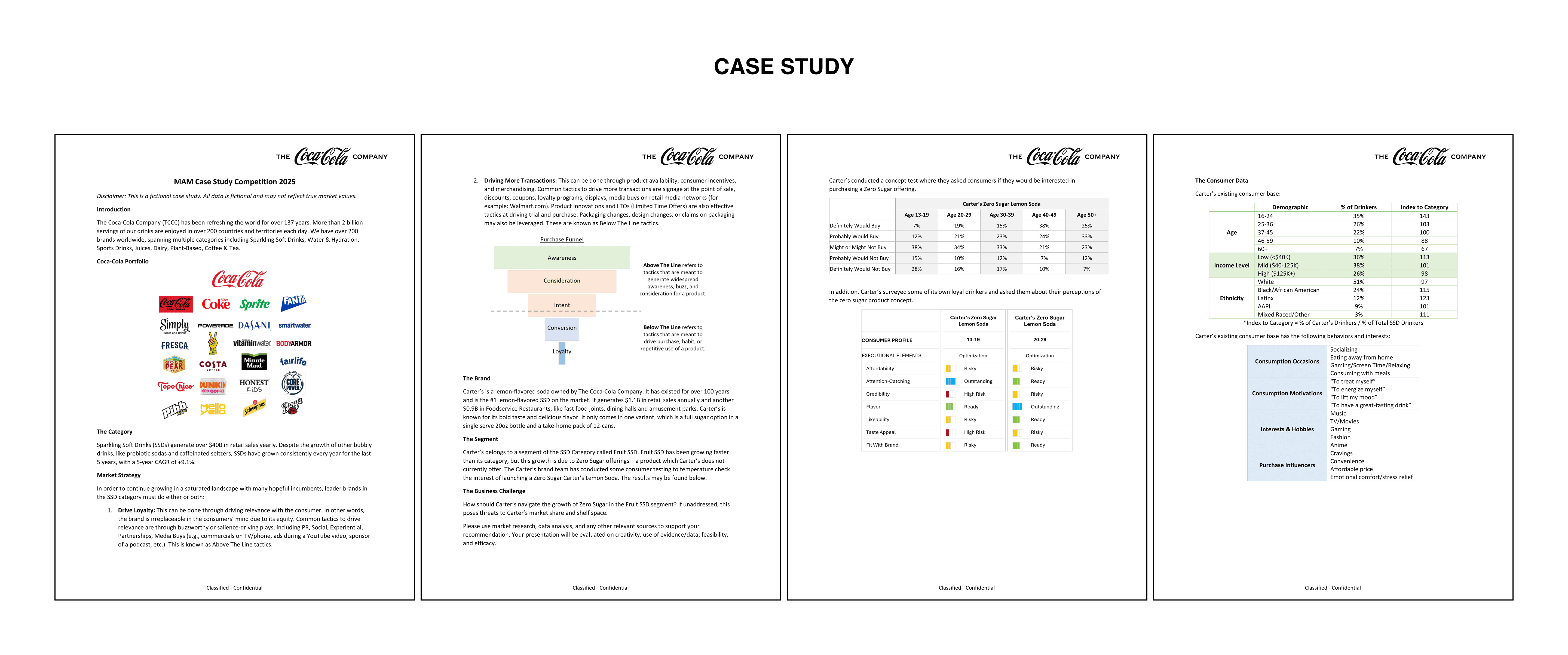
Carter’s Lemonade is a fictional lemon-flavored soda owned by The Coca-Cola Company. As per the case study provided by Coca-Cola, the soda has a strong brand identity, existing for over 100 years and becoming the #1 lemon-flavored Soft Sparkling Drink (SSD) on the market. The drink is constantly found in food service (restaurants, like fast food joints, dining halls and amusement parks), known for its bold taste and delicious flavor.
Challenge
How should Carter’s navigate the growth of Zero Sugar in the Fruit SSD segment?
Carter’s belongs to the Fruit SSD segment which has been rapidly growing due to Zero Sugar variants—a product which Carter’s does not currently offer. If unaddressed, this poses threats to Carter’s market share and shelf space. Our solution must utilize both above-the-line and below-the-line marketing strategies to 1) drive customer loyalty and consumer relevance and 2) increase transactions.
Opportunity
Design a Zero-Sugar version of Carter's Lemon-Flavored Soda and create an omnichannel marketing campaign to pitch the variant to panelist of executive judges from The Coca-Cola Company.
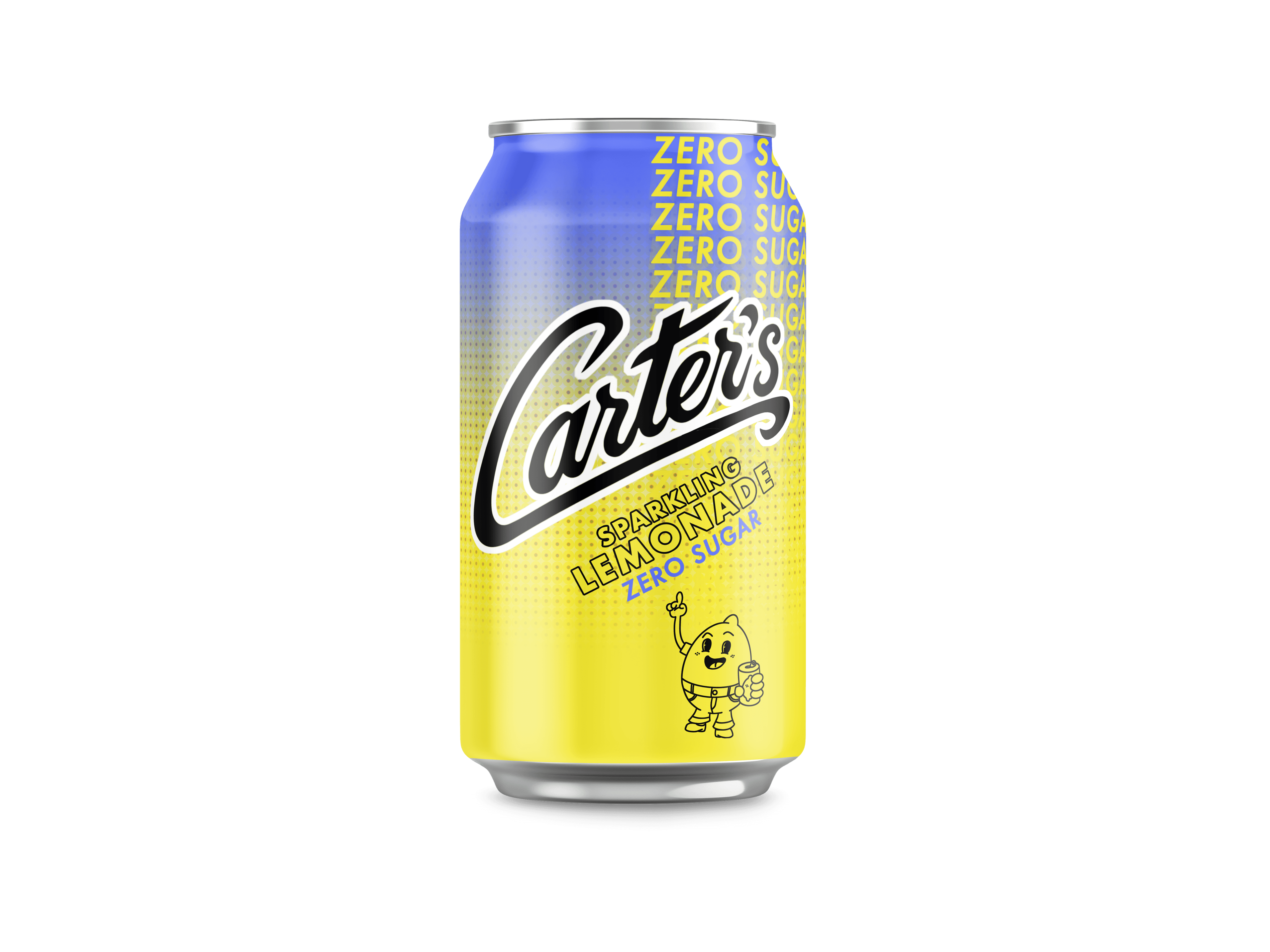
Our team firstly conducted competitive analysis on products in the SSD category, in which I collaborated with co-designer Eve Ellis to analyze the appeal of top competitors' soda can designs. Identifying crucial elements like bold colors and high contrast, we aimed to distinguish our concept product as a “better alternative to soda.” We developed a modern and joyful brand identity for the launch of Carter’s Zero-Sugar Lemonade, encompassing soda can packaging, revamped logos, digital mockups of advertisements, and a visually compelling themed pitch deck.
All marketing appeals to the original customer base of consumers aged 16-24, highlighting endless opportunities of adventure that can be done with a Carter's Zero Sugar at hand.
Process
Project Process
Research
Identifying Problems
Desk Research
Competitive Analysis
Synthesis
Research Insights
Pain Points
User Needs
Ideation
Moodboard
Style Guide
Final Deliverables
Mascot Design
Can Design
Advertisement Mockups
Pitch Deck
Reflections
Further Explorations
Research
User Research
As per the case study, SSDs generate over $40B in retail sales yearly. Despite the growth of other bubbly drinks, like prebiotic sodas and caffeinated seltzers, SSDs have grown consistently every year for the last 5 years. The existing Carter's product has generated $1.1B in retail sales annually and an additional $0.9B in food service.
Carter’s existing consumer base is as follows:
Age: 35% of consumers lie within the age group of 16-24, while 26% are ages 25-36, and 22% are ages 37-45.
Income Level: 38% of consumers lie within the income level of $40-125K, 36% make less than $40K, and the remaining 26% make over $125K.
Ethnicity: 51% of consumers are White, 24% are Black, 12% are Latinx, and 9% are AAPI.
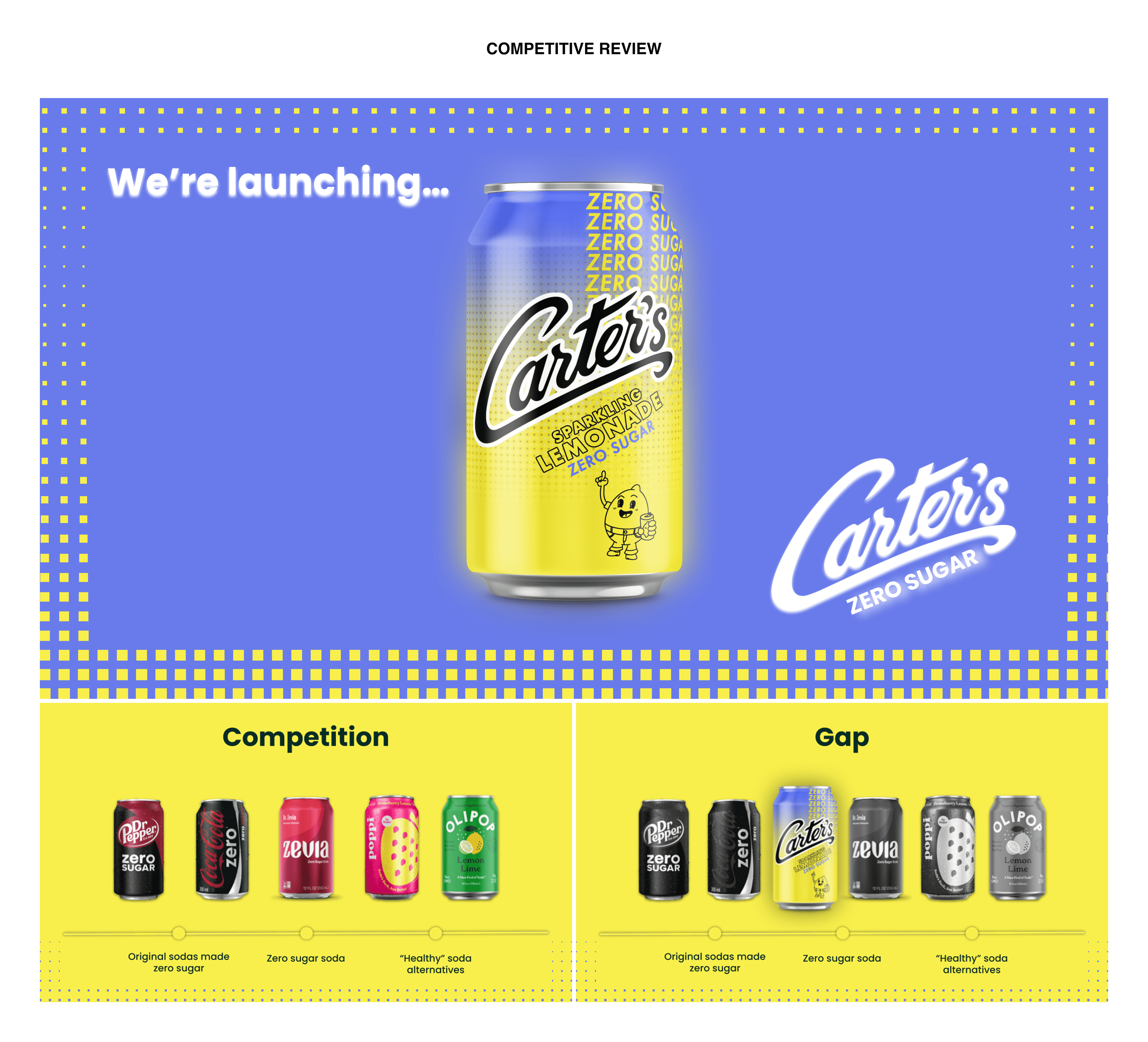
Competitively reviewed existing "soda alternative" products to identify where brands place in spectrum of SSDs and to study brands' visual storytelling, zero-sugar packaging designs, and brand identities
Synthesis
Our competition in SSDs encompasses Zero-Sugar versions of traditional sodas like Dr. Pepper and Coca-Cola, originally Zero-Sugar drinks like Zevia, and prebiotic sodas marketed as healthier options, such as Poppi and Olipop. Since the existing product has demonstrated success in the market, there will be an established audience for the launch of a Zero-Sugar alternative. In the spectrum of SSDs, the concept product would lie between original sodas made Zero-Sugar and Zero-Sugar soda.
Based on the existing consumer base, we broke down our marketing strategies into three target audience segments to keep our customer populations of young people, adults, and families in mind:
Gen Z (16-24): Social Media Marketing, Digital Advertising, ESports Sponsorships
Millennial (25-36): Restaurant Promotions, Audio Streaming, Airport Advertisements
Adult (37-49): Grocery Store Promotions, Sampling Events, In-Store Signage
Ideating
Ideation
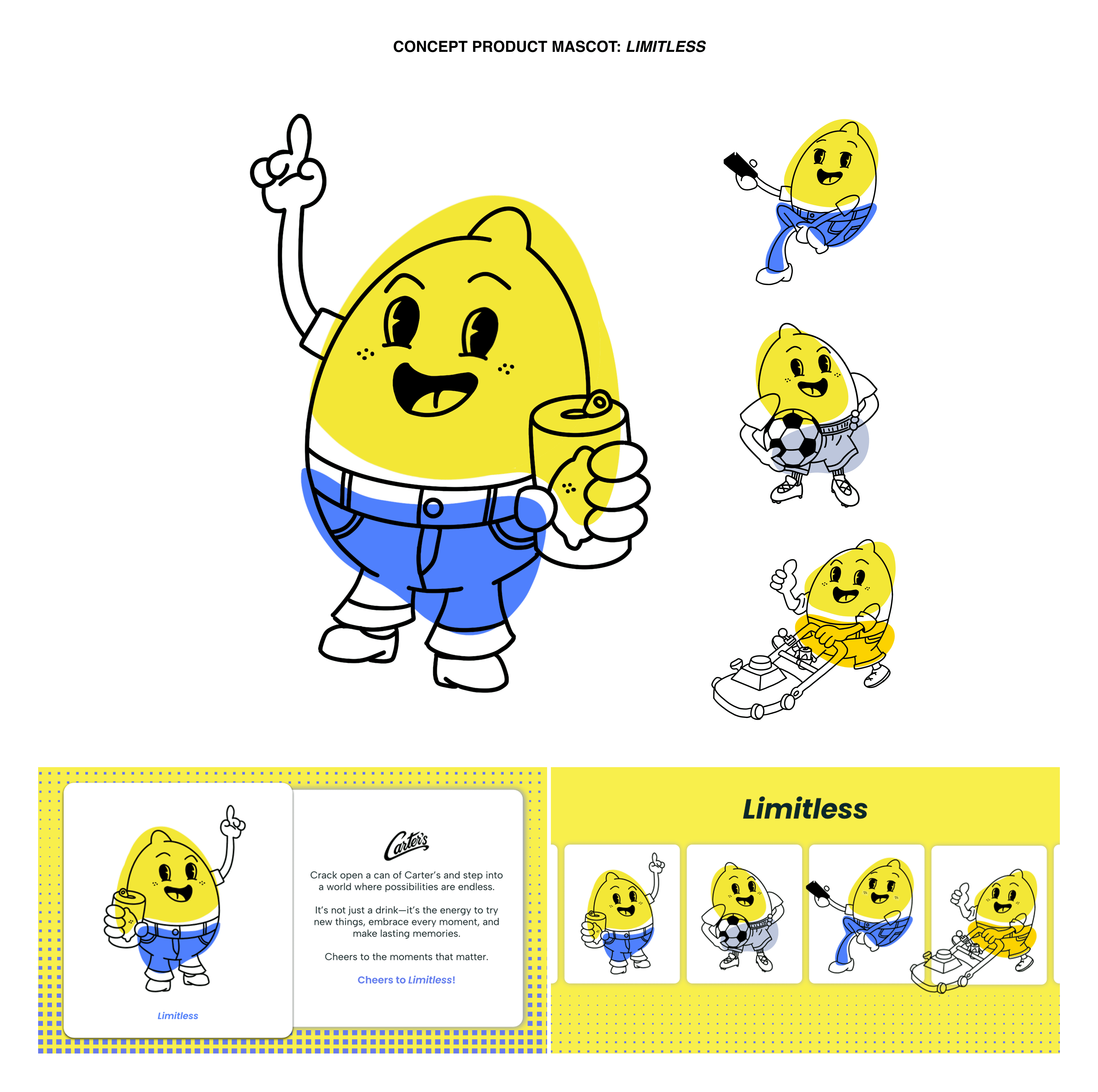
To distinguish our Carter’s Zero-Sugar Lemonade in the market, I created and designed the mascot, Limitless, characterized as an adventurous personality that accompanies the consumer as they engage in any form of activity. Limitless serves to represent the versatility of Carter’s Zero-Sugar Lemonade; from simply lounging on the couch to absolutely killing it at a soccer tournament, Limitless is more than happy to join you in any of your various adventures.
Final Designs
Final Designs
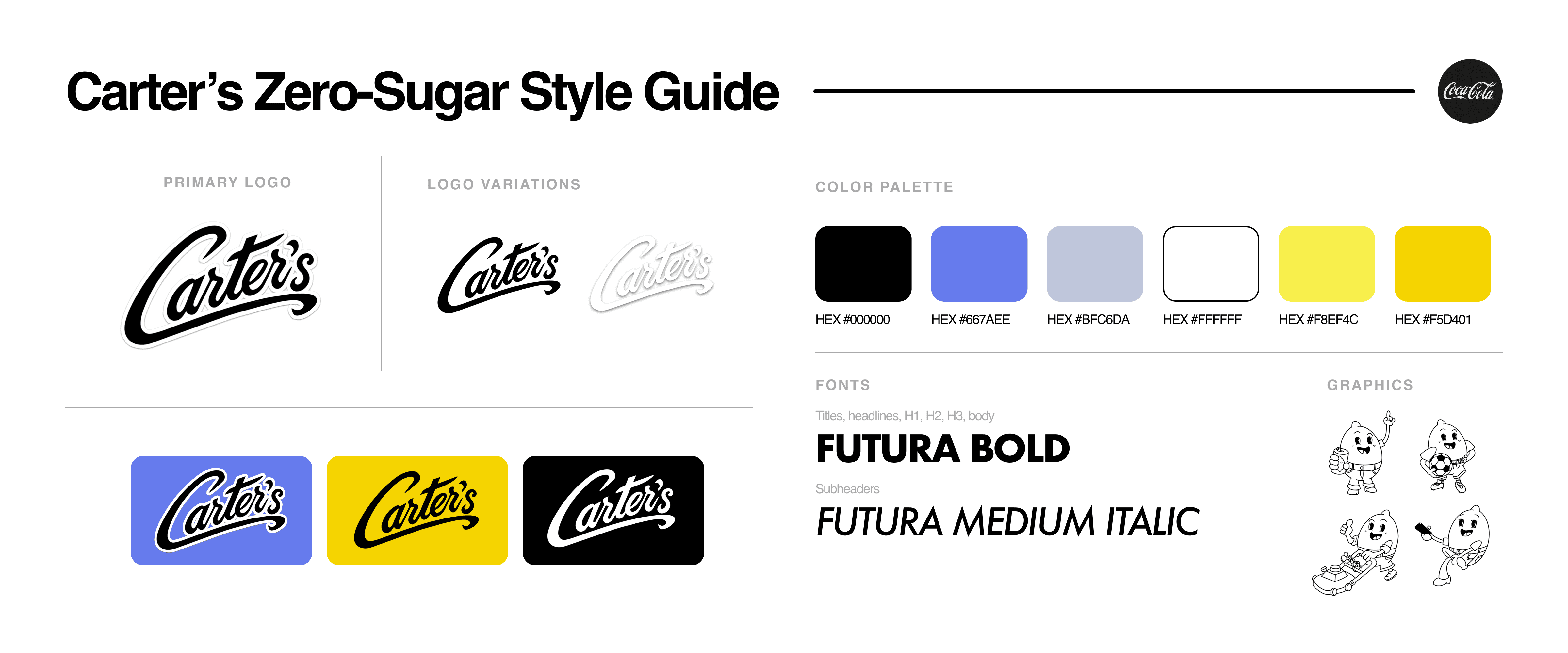
Alongside Limitless, I created a concept design for Carter's Zero-Sugar Lemonade soda can, inspired by the existing products we researched. By strategically incorporating bold fonts, bright colors of high contrast, halftone effects, and gradients, I aimed to design a product that effectively suited our brand message: Our product is more than a delicious, sparkling drink — it's an exciting experience, enjoyable by anyone, doing anything, anywhere.
As part of our marketing strategy, I also created graphics for billboard and digital advertisement mockups. Eve and I then compiled all aspects of this concept product into a pitch deck that matched our brand identity.
Across all visual elements created for this case, we carefully considered aesthetic choices to ensure they would resonate with and engage the diverse demographics of our target audiences, particularly in regard to age.

Product Demo
Interactive Prototype
Reflections
Balancing Strategy and Visual Appeal
Working on Carter’s Zero-Sugar Lemonade was an intensive but rewarding two-week sprint that pushed me to expand my skills in both branding and strategic design. Considering this was my first time participating in an official case competition moderated by company staff, I learned how to balance fast-paced research with rapid design iteration, ensuring that our creative decisions were grounded in market insights rather than aesthetics alone.
Developing the mascot, Limitless, was definitely a highlight of the project for me; this process challenged me to create a character-driven brand identity that could exist across multiple touchpoints—cans, billboards, digital campaigns, etc. Designing Limitless gave me hands-on experience in extending branding into a more playful, lifestyle-driven direction that would resonate with our various target audiences.
Delivering to Industry Leaders
Presenting our deliverables to a panel of Coca-Cola executives as finalists in this case competition was both nerve-wracking and incredibly insightful. The experience gave me confidence in pitching creative work to industry leaders, reinforcing the importance of clear communication, storytelling, and brand consistency in professional presentations. Our Creative Design team received lots of positive feedback while being reminded of the importance of consistent phrasing within the beverage industry.